 Whalesbook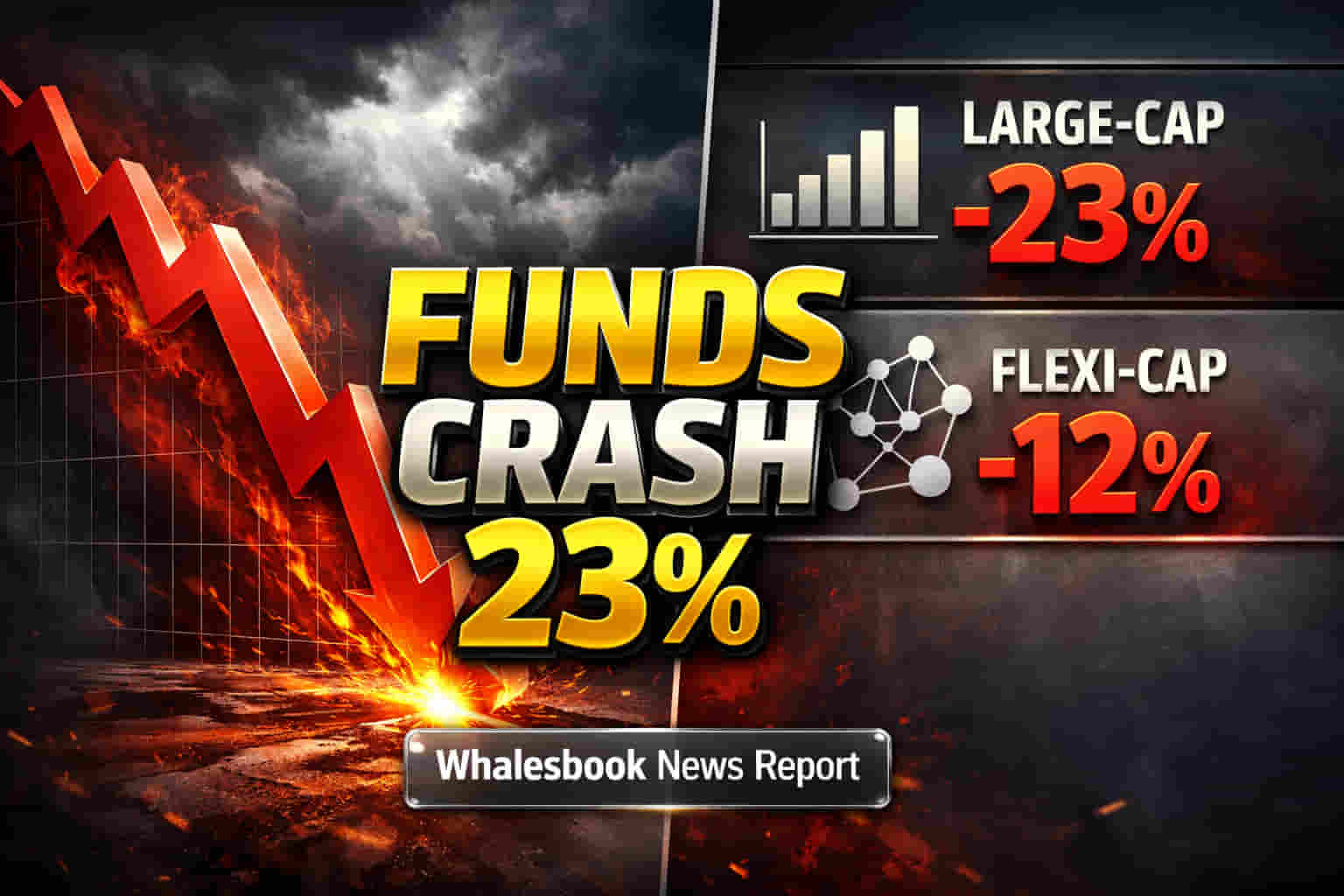


Flexi-Caps Underperform During Market Slump
Indian equity mutual funds faced a significant market downturn lasting about 18 months, from late September 2024 to early March 2026. During this period, large-cap funds lost an average of 6.98%, while flexi-cap funds, designed for adaptability, saw a larger average decline of 8.67%. The results suggest that flexibility did not protect investors from the broader market drop, leading to bigger average losses and a wide spread of results within the flexi-cap category.
Wide Performance Gaps in Flexi-Cap Funds
The market correction affected major indices, including the Nifty 50 (down 5.20%) and BSE Sensex (down 6.84%) from September 2024 to March 2026. Large-cap funds showed relative stability, with some like Motilal Oswal Large Cap Fund losing only 1.16%. However, flexi-cap funds displayed significant differences in performance. While HDFC Flexi Cap Fund (0.33%) and Parag Parikh Flexi Cap Fund (0.32%) achieved small gains, Samco Flexi Cap Fund dropped sharply by 23.38%. This difference of 23.7 percentage points between the best and worst flexi-cap performers highlighted how general flexibility was not enough during high volatility, pointing to potential strategic issues for many fund managers.
Global Factors and FII Outflows Fuel Market Downturn
A mix of global economic and political issues worsened the market slump. Rising global tensions and conflict in the Middle East pushed oil prices to multi-year highs, increasing inflation worries for India, which imports most of its oil. Foreign institutional investors (FIIs) also pulled money out, selling a record ₹1,66,283 crore from Indian equities in 2025 and continuing sales into early 2026. This reduced market liquidity and pressured prices. By March 2026, the Nifty 50’s P/E ratio was around 21.02, and the MSCI India Index PE was 25.09 in February 2026. While valuations weren't extremely high, sentiment was negative, particularly hurting small and mid-cap stocks. Debt funds offered a stable alternative, returning between 3.87% and 10.68%, in contrast to negative equity fund returns.
Flexibility's Downside in a Bear Market
The prolonged market drop revealed weaknesses in how flexi-cap funds were managed. Their wide mandate to invest across different company sizes, theoretically a strength, often failed to deliver strong returns or even protect capital for many funds. The huge range in performance, from small gains to large losses, suggests inconsistent strategies and risk management by fund managers. Many flexi-cap portfolios appeared unprepared for extended negative market sentiment, showing that flexibility alone couldn't overcome broader market pressures. Even funds known for stability during downturns, like Parag Parikh Flexi Cap, saw only small gains. Quant Large Cap (-12.33%) and Quant Flexi Cap (-15.88%) were among the worst performers, showing how aggressive approaches can falter significantly during prolonged market declines.
AUM Grows Despite Performance Concerns
Despite recent poor performance, flexi-cap funds continue to attract investors. Assets under management (AUM) in this category grew by 148.28% in the four years leading up to December 2025, reaching ₹5.52 lakh crore. This growth is driven by investor interest in the sector's adaptability and diversification. The Indian mutual fund industry's total AUM surpassed ₹81.01 lakh crore by January 2026, supported by strong Systematic Investment Plan (SIP) inflows and consistent retail investment. However, the past 18 months serve as a clear message: while flexibility is desirable, consistently delivering solid, risk-adjusted returns, especially during tough markets, will be the key challenge for flexi-cap fund managers.